

Introduction
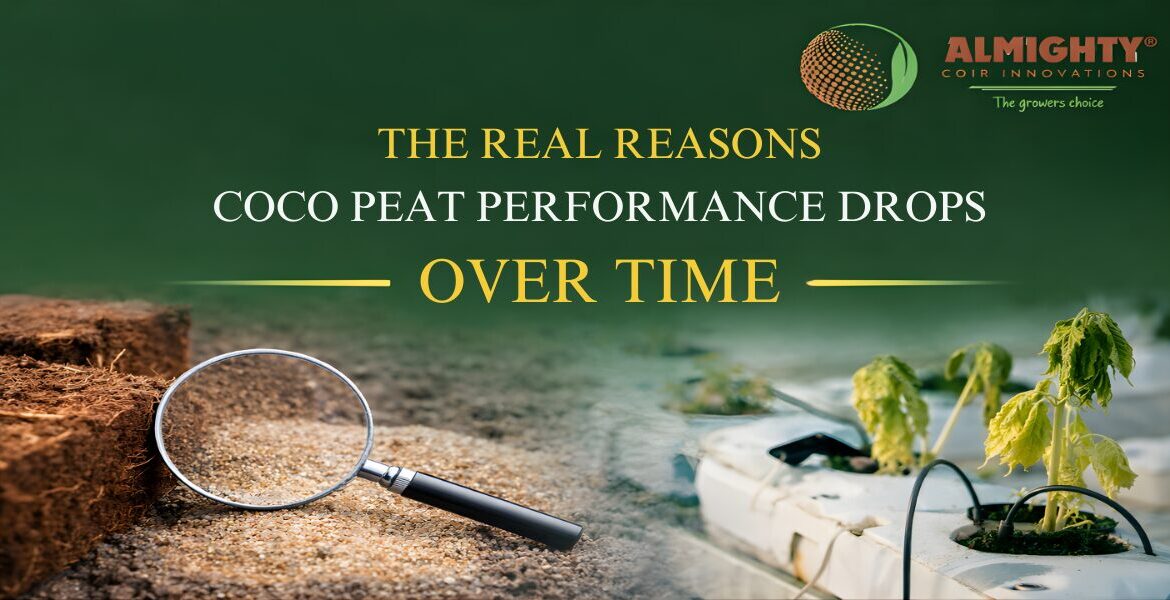
Coco peat is trusted worldwide for its water retention, aeration, and root support. Yet many growers and buyers experience a drop in performance after repeated use or during crop cycles. This decline is often misunderstood and wrongly linked to irrigation methods or nutrient programs.
In reality, the main reasons are related to product quality, especially sand content and impurities present in the coco peat. Understanding these factors helps growers, nurseries, and importers choose better material and avoid long-term issues.
Impact of Sand Content in Coco Peat
Sand content plays a major role in determining how well coco peat performs over time.
When excess sand is present, it increases the dead weight of the product. Sand does not help with water retention or aeration, yet it adds unnecessary weight to coco peat blocks or bales.
During expansion, coco peat fibers absorb water and expand. Sand does not swell. This leads to lower expansion volume per block, meaning buyers receive less usable growing media than expected. Over time, this results in dissatisfaction and product claims.
High sand content also affects root penetration and drainage balance. Roots face resistance, water movement becomes uneven, and oxygen availability reduces. These factors directly impact plant growth and crop uniformity.
For exporters, excess sand reduces container efficiency. Weight limits are reached faster, allowing fewer functional blocks per container. This results in poor value per shipment, a key concern for any coco peat exporter in India.
Curious whether coco peat or soil works best?
Read our blog on coco peat vs soil to discover what makes the difference.”
Impact of Impurities in Coco Peat
Impurities are another hidden reason for declining coco peat performance.
Common impurities include fiber lumps, wood chips, husk pieces, stones, and other foreign materials. These materials disturb the natural structure and consistency of coco peat.
When texture is not uniform, water holding and aeration become uneven. Some areas remain wet while others dry out quickly. In nursery trays and hydroponic systems, impurities restrict root development, leading to weak or uneven plant growth.
Foreign materials can also increase the risk of blockage in drip irrigation systems, affecting irrigation efficiency. Poor impurity control may cause unstable EC and pH behavior, making nutrient management more difficult for growers.
From a market perspective, visible impurities reduce buyer confidence and often fail quality inspections at export destinations, affecting acceptance and long-term partnerships.
Impact of High Sand Content in Coco Peat Blocks
Coco peat blocks with high sand content show clear performance issues after hydration.
Because sand does not expand, blocks produce less expanded volume, which affects planting density and media usage. Over time, growers notice reduced drainage efficiency, weaker root systems, and slower plant development.
These issues are not caused by the crop or growing method but by inconsistent raw material quality.
Why Quality Control Matters in Coco Peat Manufacturing
True coco peat quality goes beyond EC values. Proper sand removal and impurity control are essential for consistent performance.
This is why buyers prefer working with an experienced Coco peat manufacturer in India who follows strict processing standards—whether supplying low EC or high EC grades.
Reliable processing ensures stable structure, predictable expansion, and long-term performance for growers.
Our Quality Approach at Almighty Coir
At Almighty Coir, coco peat is processed with a strong focus on consistency and performance.
- Sand content is maintained at around 3% only
- Advanced screening reduces fiber lumps and foreign materials
- Both low EC and high EC coco peat are processed under the same quality controls
This careful approach allows Almighty Coir to deliver dependable coco peat for domestic and international buyers, strengthening its position as a trusted low EC coco peat manufacturer in India and high EC coco peat exporter in India.
Final Thoughts
When coco peat performance drops over time, the reason often lies within the product itself. Excess sand and impurities reduce expansion, affect roots, and lower overall growing efficiency.
Choosing coco peat from a reliable supplier with strict quality control helps growers achieve consistent results and long-term success.
FAQS
- Why does coco peat expand less than expected after soaking?
Because excess sand in the coco peat does not swell, reducing the final expanded volume. - Why does coco peat feel heavy but perform poorly in growing beds?
High sand content adds weight without improving water retention or aeration. - Can impurities in coco peat affect plant root growth?
Yes, impurities disturb the media structure and restrict uniform root development. - Why do some coco peat blocks cause drainage or irrigation issues?
Foreign materials and uneven texture can block water flow and disrupt drainage balance. - Why is sand content important for coco peat exports?
Lower sand content allows better container value by delivering more usable growing media within weight limits.