

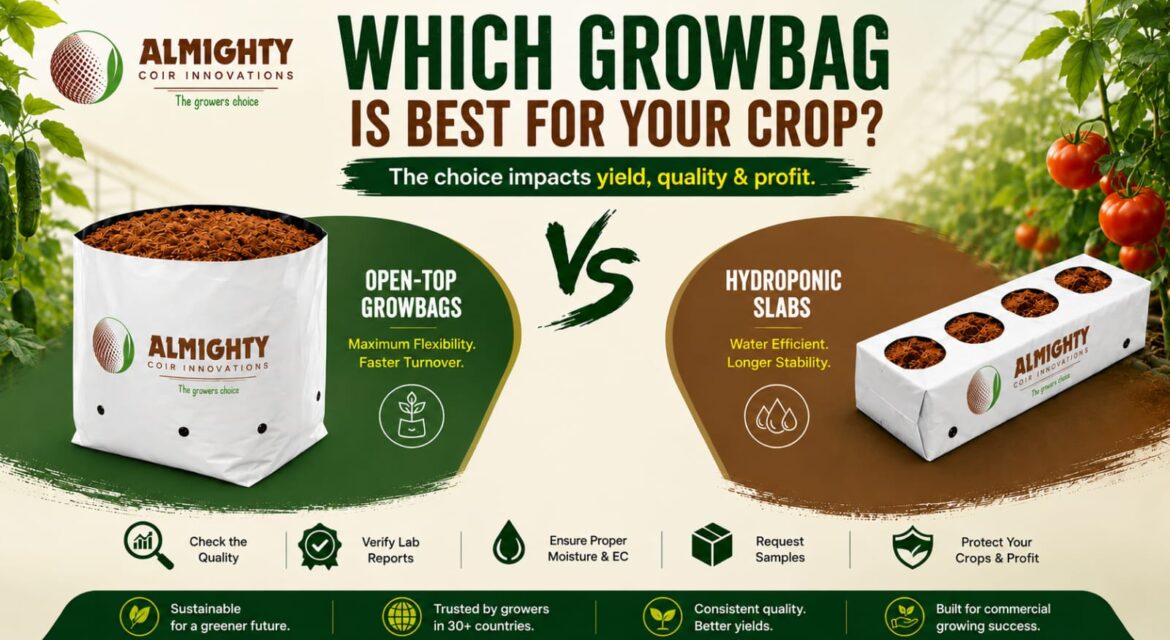
Choosing between an open top grow bag and a grow bag slab comes down to one question: how is the crop actually grown? Open top grow bags are built for direct, no-cut planting — the seedling goes straight into the substrate and irrigation starts immediately. Because each plant sits in its own individual root zone, these bags also make crop replacement simpler and limit how easily disease spreads from one plant to the next, which is a big part of why they’re favoured for crops like cucumbers alongside their role in nursery propagation, terrace gardening, flower production, and leafy greens and herbs. Commercial nurseries across South Korea, Japan, and China rely heavily on this format for raising seedlings and young plants before they’re transplanted into larger greenhouse systems, while terrace and home-scale vegetable growers across Australia and Belgium favor the same open-top design for its simplicity, instant usability, and easier disease containment.
Grow bag slabs take a different approach. Designed to lie flat inside greenhouse channels and gutter systems, they give roots a larger, shared growing zone that holds moisture more evenly, keeps EC more stable, and makes water use more efficient overall — which is exactly why they’re the go-to for long-duration, high-density crops. Tomatoes, capsicum (bell peppers), cucumbers, and strawberries are the classic slab crops, and this is what drives demand in greenhouse-heavy markets like the Netherlands, Spain, and Belgium, where rows of slab-grown tomatoes and peppers stretch across vast poly house operations.
The crop-to-format match becomes even clearer once you look beyond Europe. In the USA, slab systems dominate commercial tomato, cucumber, and strawberry production in controlled-environment greenhouses, while open top bags are widely used in nursery and ornamental plant operations. Japan and South Korea show a similar split — slabs for greenhouse tomato and strawberry production, open top bags for nursery seedlings and smaller-scale vegetable cultivation. China’s rapidly expanding protected-agriculture sector uses both formats depending on the size and sophistication of the operation, with slabs increasingly adopted for tomato and cucumber greenhouses and open top bags remaining the standard for seedling nurseries. Peru and Brazil have seen rising demand for both formats in soft fruit cultivation, particularly blueberries and strawberries, as growers move away from soil-based systems. Egypt’s greenhouse export sector leans toward slab cultivation for cucumbers and sweet peppers destined for European markets, and Australia’s protected cropping industry uses slabs extensively for berries and vegetables while keeping open top bags in steady use across nurseries and terrace-scale growing. Israel’s precision-agriculture greenhouses follow a similar pattern to the Netherlands, running slab systems for high-yield peppers and tomatoes, while Iran’s expanding protected cultivation sector has started adopting both formats as growers move away from open-field and soil-based methods.
Why the Growing Medium Matters as Much as the Bag
Whichever format you choose, the substrate inside it does most of the work. Coco peat, made from processed coconut husk, is the standard fill for both open top grow bags and grow bag slabs because of its natural water-holding capacity, good aeration, and consistent structure batch after batch — qualities that matter enormously once you’re running thousands of bags across a commercial greenhouse. A properly washed, buffered, and graded coco peat growing medium behaves predictably under irrigation, which is exactly what large-scale growers need when managing EC and moisture across an entire poly house.
This is also where the manufacturing process behind the bag becomes relevant to buyers sourcing in bulk. Coco peat manufacturing involves husk retting, defibering, screening, and controlled compression into blocks or slabs, followed by washing and buffering to bring EC and pH within a safe range for cultivation. Reliable coco peat manufacturers in India follow this process closely and test each batch against defined coco peat specifications — EC, pH, moisture content, expansion ratio — before it ships, since inconsistent specifications are one of the most common reasons commercial crops underperform. For growers comparing suppliers, checking whether a manufacturer publishes these specifications, and whether their coco peat production process includes washing and buffering as standard steps, is a fair way to separate a serious supplier from a basic one.
Sizing and Sourcing for Commercial Operations
Bag size, fill volume, and slab dimensions all need to match the crop and the greenhouse layout, which is why any grower moving to scale should work off a proper grow bag size guide rather than guessing. Open top bags for nursery and seedling use are typically smaller and lighter, built for handling in large numbers, while slabs for tomato, cucumber, capsicum, and strawberry production are sized to match standard greenhouse gutter and channel widths. Getting this wrong at the sourcing stage is expensive to fix later, so working with a manufacturer who can advise on sizing based on your crop and system — not just sell a fixed catalogue size — tends to save growers real money over a season.
For commercial buyers, whether you’re running a greenhouse in Spain or the Netherlands, a nursery in Japan or South Korea, or a soft fruit operation in Peru or Brazil, sourcing in bulk from a coco peat grow bag manufacturer that also exports means fewer intermediaries, more consistent quality control, and a supplier who understands the specification requirements of international markets. India has become a significant coco peat exporter globally, largely because coconut husk is available in volume and processing costs remain competitive, which is why growers across Australia, Egypt, Israel, Iran, and the USA increasingly source their coco peat grow bags and slabs directly from Indian manufacturers rather than regional distributors.
Making the Right Call for Your Operation
There isn’t a single universal answer here — the right substrate format depends on a handful of practical factors: the crop type, your irrigation strategy, the greenhouse climate, how long the crop stays in production, and how much disease risk you’re managing. Whichever format fits your operation, the right choice ultimately comes down to matching the grow bag’s design to how your crop roots, drains, and scales in your specific growing system — and to sourcing it from a manufacturer who can back that decision with consistent specifications, bulk supply capacity, and export experience.
If you’re planning a new greenhouse setup or reviewing your current substrate program, our team can help you work out the right format, size, and volume for your crop and region — reach out to discuss your requirements.
FAQs
- What’s the main difference between an open top grow bag and a grow bag slab?
Open top bags give each plant an individual root zone for direct planting, while slabs provide one shared root zone designed for gutter and channel systems. - Which crops grow best in open top grow bags?
Nursery seedlings, leafy greens, herbs, flowers, and crops like cucumbers where disease isolation matters most. - Which crops are best suited to grow bag slabs?
Long-duration, high-yield crops such as tomatoes, capsicum, cucumbers, and strawberries in commercial greenhouses. - Why is coco peat used as the growing medium in both formats?
It holds water evenly, allows good root aeration, and stays consistent across large batches when properly washed and buffered. - Can grow bags and slabs be sourced in bulk for export?
Yes, manufacturers supplying international greenhouse and nursery operations typically offer bulk volumes with defined specifications for export.