

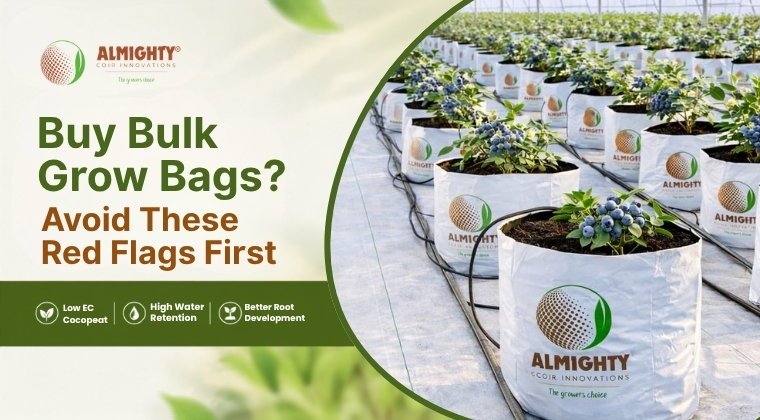
Buying grow bags in bulk for a commercial greenhouse or nursery operation is a very different decision from picking up a few bags for a backyard garden. One bad container of substrate can set back an entire crop cycle, and by the time the problem shows up in the roots, it’s usually too late to send it back. Knowing what to check before you commit to a bulk order — and which suppliers skip these checks — can save a season’s worth of losses.
Red Flag #1: A Supplier Who Doesn’t Ask About Your Crop
The first warning sign shows up before you’ve even placed an order. Open top grow bags and slab bags serve very different growing systems, and a supplier who pushes the same format regardless of what you’re growing hasn’t taken the time to understand your operation.
If you’re growing high-density crops like tomatoes, capsicum, cucumbers, or strawberries in greenhouse channels — standard practice across the Netherlands, Spain, Belgium, and large parts of the USA — you need slab-format grow bags that lie flat and hydrate evenly across the row.
If you’re running a nursery, propagating seedlings, or growing terrace crops, herbs, and leafy greens — common practice in South Korea, Japan, and China’s fast-expanding protected-agriculture sector — an open top grow bag built for direct, no-cut planting is what actually performs.
A supplier who quotes a price without asking which one you need is the first sign to slow down.
Red Flag #2: Vague or Missing EC and pH Data
This is where bulk orders start costing real money, and often only after the container has already landed.
Cocopeat that hasn’t been properly washed carries excess salts that can damage sensitive seedlings and young transplants. This is a risk that growers in Peru and Brazil’s expanding blueberry and strawberry operations screen for carefully, since soft fruit roots are unusually sensitive to salinity swings. Any supplier who can’t hand you clear, batch-specific EC and pH figures shouldn’t be trusted with a full container order.
Red Flag #3: No Moisture Content or Batch Test Reports
Be cautious of suppliers who can’t confirm moisture content or provide batch-level test reports. Inconsistent drying is one of the leading causes of mold risk during long sea transit to markets like Australia, Egypt, or Iran — routes where a container can spend several weeks at sea before it ever reaches a growing operation. A manufacturer with proper batch documentation should be able to produce this data without hesitation.
Red Flag #4: Uneven Compression on Slab Bags
Inconsistent compression ratios on slab bags are another warning sign worth checking closely. A slab that doesn’t expand evenly across its full length creates dry pockets and waterlogged zones within the same row — a problem greenhouse operators growing cucumbers and sweet peppers for export, as is common in Egypt’s protected-agriculture sector, cannot afford at commercial scale. Ask for compression and expansion data before finalizing any slab bag order, particularly for greenhouse rows running the length of a full channel.
Red Flag #5: No Sampling Before Bulk Commitment
Finally, be wary of any bulk quote that comes without sampling, documentation, or a clear minimum order breakdown. A reliable manufacturer will always let you test a sample batch before you commit to a full container — regardless of which growing system, crop, or export destination you’re sourcing for. If a supplier resists sending samples or is vague about MOQs, treat that as a signal to keep looking.
Sourcing With Confidence
Commercial growers across the Netherlands, Spain, Belgium, USA, South Korea, Japan, China, Australia, Egypt, Israel, Peru, and Brazil rely on consistent, well-tested substrate to protect crop cycles that often run for months at a time. The right grow bag supplier should be able to answer questions on EC, pH, moisture content, and compression without hesitation — and should never be pushing a one-size-fits-all format across different growing systems.
FAQs
- What’s the difference between open top grow bags and slab bags?
Open top grow bags are designed for direct planting of seedlings, herbs, and terrace crops, while slab bags are built to lie flat for high-density greenhouse rows growing crops like tomatoes and cucumbers. - Why does EC level matter in bulk cocopeat orders?
High EC indicates excess salt content, which can damage sensitive seedling roots and young transplants, especially in soft fruit crops like strawberries and blueberries. - How can I check if a grow bag supplier is export-ready?
Ask for batch-level moisture and quality test reports, since inconsistent drying increases mold risk during long sea transit to distant markets. - Should I request a sample before placing a bulk grow bag order?
Yes, a reliable manufacturer will always offer sampling and clear documentation before asking you to commit to a full container order. - Why does compression consistency matter for slab bags?
Uneven compression causes some sections of the slab to stay dry while others waterlog, which affects root health across the same growing row.