

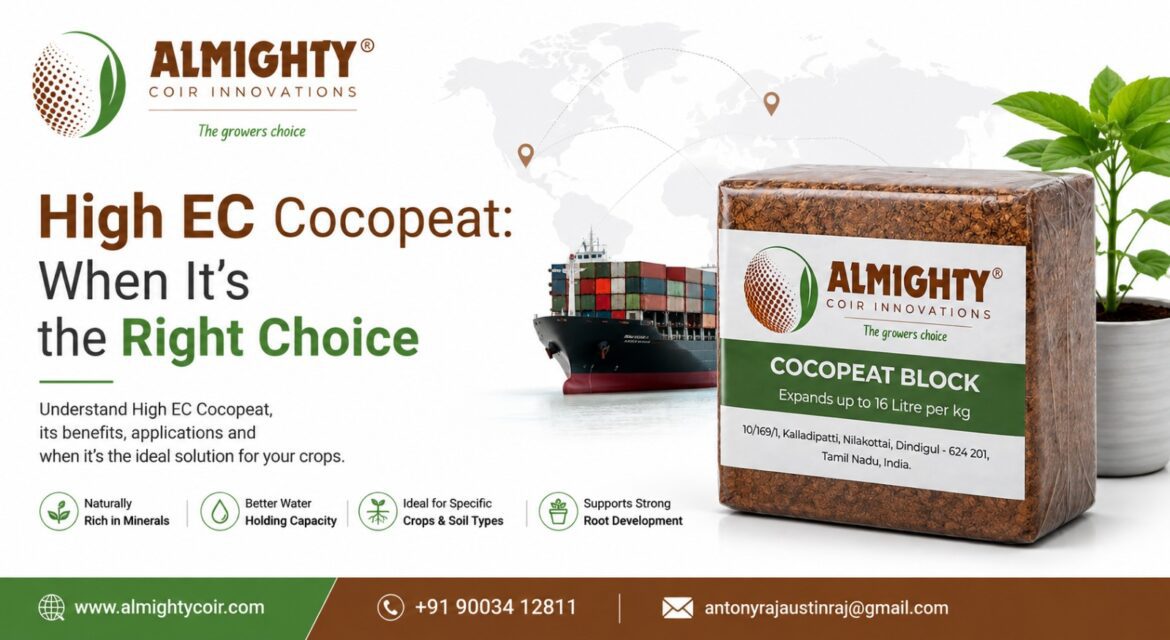
Most first-time cocopeat buyers hear “high EC” and assume they’re looking at a defect. It’s an understandable reflex — low EC has been marketed as the safe, default option across the trade for so long that anything above it starts to look like a corner someone cut. But electrical conductivity isn’t a scorecard for quality. It’s simply a measure of the salts and minerals still sitting in the substrate. Whether that’s a problem or an advantage depends entirely on what you’re growing and how.
What EC actually tells you
Cocopeat picks up natural salts and minerals during processing — sodium, potassium, chlorides, the residue of the coconut husk itself. Washing removes most of that, which is why low EC cocopeat exists as a category in the first place: it gives growers a near-blank canvas to build their own nutrient program on. High EC cocopeat skips that step, or does far less of it, and keeps more of that mineral load intact.
Neither version is inherently better. They’re built for different jobs, and treating one as the automatic upgrade over the other is where a lot of buying decisions go wrong before the crop even gets planted.
Where high EC earns its place
Some crops are bred to tolerate, or even benefit from, a certain baseline of salinity. For growers working with saline-tolerant varieties, stripping the substrate down to near-zero EC doesn’t help — it just removes a mineral baseline the crop is already adapted to use. A washed substrate can end up working against the plant rather than for it.
The same logic applies to hydroponic setups running tightly controlled fertigation programs. When a grower is dosing every nutrient precisely, a substrate that’s already been washed and buffered can actually complicate the math. Some growers would rather start from a known raw baseline and calibrate their feed around it than fight a substrate that’s been engineered to be neutral. And there’s a simpler case too: some growers just don’t want a substrate that strips out naturally occurring nutrients before the plant ever gets a chance to use them.
This is particularly relevant for buyers in places like the Netherlands and Spain, where substrate is one input among many in a system that’s controlled down to the decimal point. In that kind of operation, the substrate isn’t expected to be a blank slate — it’s expected to be a known, stable quantity that the rest of the program is built around. Raw, unwashed cocopeat with a documented EC range fits that role better than a low EC substrate that’s already had its mineral content engineered out.
High EC isn’t a lower bar — it’s a different one
Here’s the part that trips buyers up: choosing high EC doesn’t mean you can relax on quality checks. If anything, it demands more of them.
Low EC cocopeat goes through a washing process that, done properly, evens out a lot of variation in the raw material. High EC cocopeat skips that correction step. There’s nothing smoothing over inconsistencies between batches — which means whatever variability exists in the raw coconut husk shows up directly in what you receive, unless the manufacturer is actively controlling for it upstream.
That’s the real dividing line between a high EC substrate worth buying and one that isn’t: whether the supplier can prove control over the raw product, not whether they’ve washed it. A serious high EC cocopeat manufacturer should be able to show you:
- A stable EC range, batch after batch — not just a single reading from one sample
- Verified pH, since raw material without a washing step can drift more than buyers expect
- Controlled moisture content, so what you’re paying for isn’t partly water weight
- Consistent sieving grade, so the physical structure of the substrate doesn’t vary from bag to bag
None of that documentation is optional just because the product is unwashed. It’s more necessary, not less.
The same standard, everywhere
This isn’t a consideration that only applies to buyers new to the category. An established greenhouse operation in Australia running a mature, dialed-in program needs the same batch consistency from a high EC substrate as an importer in Egypt or Peru who’s testing it for the first time. A buyer in Japan sourcing for a demanding, quality-conscious market has just as much reason to ask for verified specs as one in any other region. The crop and the system determine whether high EC is the right call. The manufacturer’s ability to document consistency determines whether it’s a safe one.
Making the decision deliberately
The point isn’t that high EC cocopeat is secretly the better choice, or that low EC has been oversold. It’s that “low EC by default” isn’t actually a strategy — it’s a habit the trade fell into because washed substrate is easier to sell as universally safe. For the right crop and the right system, that habit can quietly work against the grower.
Choosing high EC over low EC should come out of a real look at what’s growing in it and how the nutrient program is managed — not out of which option sounds more processed and therefore more reassuring. And it should only be made with a supplier who can back the raw product with the same rigor a washing process would otherwise provide: documented EC, verified pH, controlled moisture, and consistent grading, batch after batch.
That’s the actual test. Not whether the cocopeat has been washed, but whether someone can prove it’s controlled either way.
For growers who’ve already matched their crop and system to a higher mineral baseline, that proof is what separates a substrate they can plan a season around from one that’s just an unwashed guess.
FAQs
Is high EC cocopeat lower quality than low EC cocopeat?
No, it just retains more natural salts and minerals suited to specific crops and systems.
Which crops benefit most from high EC cocopeat?
Saline-tolerant crops and precisely managed hydroponic fertigation systems benefit most.
Does unwashed cocopeat mean less consistent quality control?
Not with a manufacturer that verifies EC, pH, moisture, and sieving grade every batch.
Is high EC cocopeat suitable for growers with tightly managed nutrient programs?
Yes, it gives growers a known raw baseline to calibrate their own feed around.
How do I know if a high EC cocopeat supplier is reliable?
Ask for documented batch consistency across EC, pH, moisture, and sieving grade.