

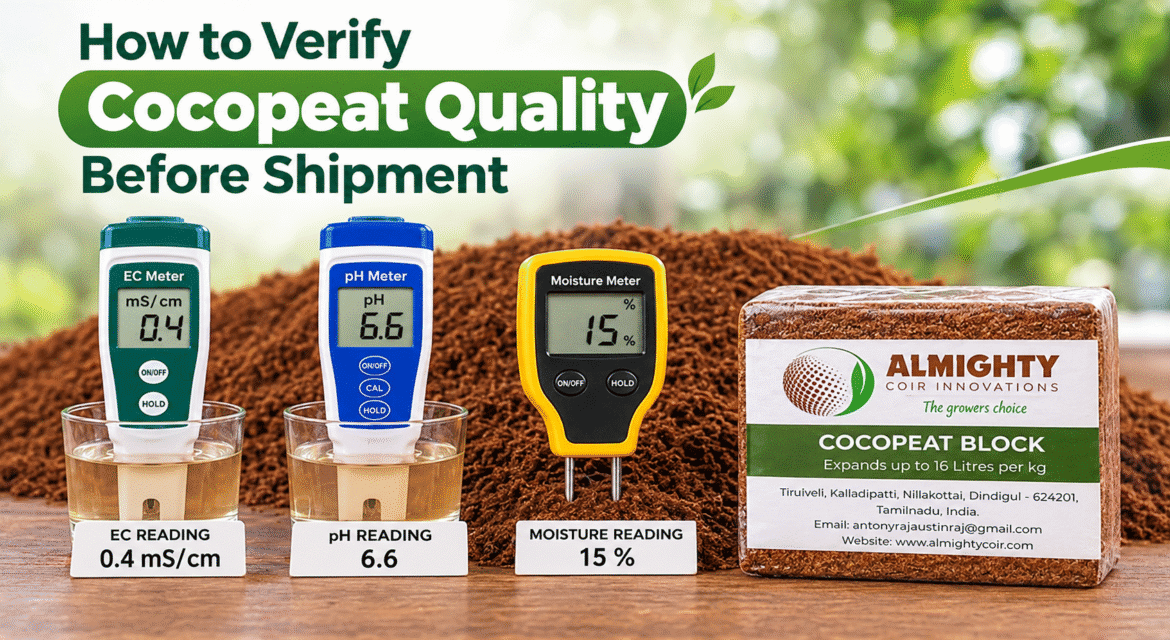
A container of cocopeat looks the same whether it meets spec or not. The difference surfaces weeks later, in a nursery in Belgium or a greenhouse in South Korea, when germination lags or EC readings drift halfway through a crop. By then the container is cleared, the invoice is paid, and the only thing left to do is trace the problem backwards.
That gap between what a supplier claims and what actually ships is where import risk lives. Closing it before the container leaves India costs a few days and a few emails. Closing it after arrival costs a crop cycle.
Here is how experienced buyers do it.
Read the lab report as if you will be questioned on it
Most buyers receive a test report and file it. The ones who avoid surprises read it line by line.
Start with EC and pH, and compare them against the range you agreed in writing, not the range on the supplier’s product page. Low EC cocopeat for hydroponic growers is commonly specified below 0.5 mS/cm, with pH in the mildly acidic band most crops prefer. Whatever your range is, the report should sit inside it with room to spare, not at the edge.
Then look at what surrounds the numbers:
- The test date. A report from four months ago says little about the material being packed this week.
- A batch or lot number. Without one, you cannot tie the report to your shipment. It could describe any pile in the yard.
- The testing method. EC is usually read on a saturated extract or a 1:1.5 dilution, and the two methods give different numbers. If the report doesn’t say which was used, ask.
- Who ran the test. An in-house lab is fine for routine checks. For a first order, an independent lab report carries more weight.
If a supplier’s spec sheet says one thing, their email says another, and the lab report says a third, stop there. Inconsistency is information.
Moisture is quieter than EC, but it costs just as much
Moisture content rarely makes it into the first conversation, which is odd, because it affects almost everything that follows. Compressed blocks that carry too much water are heavier than they should be, which means you are paying freight on water. They are also more prone to mould in transit, particularly on longer sea routes with humid port stops.
Ask for the moisture reading on the same batch as the EC and pH report. A well-run exporter will have it to hand. If the answer is “around 15 to 20%” with no measurement behind it, that is a guess, not a test.
Sieving tells you what is actually in the block
Particle composition shapes how the substrate behaves in a bag: how it holds water, how it drains, how roots move through it. A mix heavy in fine dust holds too much moisture and can compact. A mix heavy in coarse husk chips drains fast and demands more frequent irrigation.
Ask how the supplier sieves, what the target ratio of fine peat, fibre and chips is, and how often they check it during production, not only at the start of a run. Consistency between blocks matters more than a single good sample. Growers in the Netherlands and Spain, who run tightly controlled fertigation, will notice a drift in structure before they notice anything on paper. So will a Japanese buyer used to very uniform inputs.
Always request a pre-shipment sample
A product page tells you what a supplier hopes to ship. A sample tells you what they can ship.
The useful kind of sample comes from the batch you are about to buy, not from a showroom shelf. Request it with the batch number written on the packaging, and send it to a lab you choose. Test EC, pH, moisture and, if the crop is sensitive, sodium and chloride. Hold a few blocks back, too: expand one, look at the texture, smell it. Cocopeat that has been properly washed and buffered doesn’t smell sharp or salty.
It takes time, and some suppliers will push back. A credible exporter won’t. They have seen this request many times and treat it as a sign of a serious buyer.
What a credible exporter provides as standard
You shouldn’t have to chase any of this:
- A quality certificate tied to the batch, dated and signed
- EC, pH, moisture and sieving data for that lot
- A phytosanitary certificate and certificate of origin
- Packing details: block weight, expansion volume, bags per pallet, container loadability
- Clear sampling and dispatch timelines
If you are importing into Australia, add biosecurity documentation to that list, since inspection requirements there are stricter than in most markets. Buyers in China, who often reprocess the raw material, should also ask about fibre length and dust content, because those figures matter more to a processor than to an end grower.
Red flags worth taking seriously
Individually, most of these are small. Together, they form a pattern.
- Test dates are vague or missing
- No batch numbers appear anywhere
- Specs change from one message to the next
- The supplier hesitates over an independent lab test
- Every answer is “no problem” with nothing attached
A supplier who tests properly is usually eager to show you the data. A supplier who doesn’t tends to get vague at exactly the moment you ask for it.
The same discipline in every market
An established importer in the USA or Australia may already have a quality-control routine. A newer buyer in Brazil, Peru, Egypt or Iran may be building one from scratch, and a Belgian or Israeli grower may be switching suppliers after a bad season. The starting points differ, but the habit that protects all of them is the same: verify before the container ships, not after it lands.
Buyers who do this tend to share one trait. They treat the supplier relationship as a working partnership, with data exchanged openly in both directions, rather than a single transaction to be survived.
If you’d like to see how this looks in practice, Almighty Coir shares batch-wise test reports and pre-shipment samples with buyers as a matter of routine. Send us your spec and your destination, and we’ll show you what verification looks like before you commit to an order.
Enquire about a pre-shipment sample →
FAQs
- What should a cocopeat quality certificate include?
Batch number, test date, EC, pH, moisture, testing method and the signing lab or authority. - How do I check cocopeat quality if I can’t visit the factory?
Request a batch-matched sample, test it at an independent lab, and compare it against the supplier’s report. - What EC and pH range is right for my crop?
It depends on the crop and fertigation plan, so agree the range in writing before ordering. - Can moisture content really affect shipment quality?
Yes, excess moisture raises freight weight and increases the risk of mould in transit. - Is a pre-shipment sample worth the delay?
Yes, a few days of testing costs far less than a crop cycle affected by out-of-spec material.